Posts mit dem Label witzig werden angezeigt. Alle Posts anzeigen

Montag, Januar 26, 2009

Wofür Eliteunis jetzt alles Geld ausgeben können


Ich gehe durchschnittlich einmal pro Tag vom Büro/Labor (der Turm im Hintergrund) zu unserem Versuchsgewächshaus (ein paar hundert Meter hinter mir) und zurück. Bisher konnte man auf dieser Strecke wertvolle Sekunden sparen, indem man zwischen den Bäumen abkürzte. Was auch viele Leute an der Uni machen, der Trampelpfad ist nicht nur von mir! Jetzt hat die Uni wohl was dagegen, dass ihr gepflegter englischer Rasen ihr naturbelassenes Unkrautbeet betreten wird, und hat eine Absperrung aufstellen lassen. Nur viel gebracht hats nicht, gleich rechts vom Bild entsteht nämlich bereits ein neuer Ausgang ;-)

Mittwoch, Dezember 31, 2008

Frohes Neues mit Sachen zum Lachen (und Mitsingen)!

Was gibt es besseres, als das neue Jahr mit einer super lustigen, eindeutig nicht jugendfreien Definition von "Wissenschaft" zu beginnen? Eben. Deshalb dieser Kommentar des Kriminaltechnikers Vince Masuka aus der dritten Staffel von Dexter:
That's not opinion, that's science. And science is one cold-harded bitch with a fourteen inch strap-on.
Adblock

Die Szene startet um 3:49, der zitierte Satz um ca. 5:40. Einfach großartig!

Ich hab noch ein zweites Video für euch. Und das kommt auch von einer Serie - es ist der Titelsong der Sitcom The Big Bang Theory. Das Lied heißt "History of Everything" und ist von den Barenaked Ladies, die ich vor ca. 10 Jahren auch mal live gesehen hab. Viel Spaß beim Mitsingen!
Adblock

Mittwoch, Dezember 24, 2008

Weihnachtspaper!

Die Firma DNA 2.0 hat nach dem Weihnachtspaper von 2006 (Santa Claes, Rudolph Reindeer, Saint Nicolas, Ness E. Tomte, Dasher Sridhar, Jeremy Elf (2006): Heterologous expression and functional characterization of the Santa Hoho2 gene. Proc Natl Acad Sci, North Pole 12:25-31. [PDF]) dieses Jahr endlich ein neues weihnachtlich angehauchtes Paper veröffentlicht!

Santa Claes, Feliz Navidad, Tomte Ness E., Ten N. Baum, Hanukkah Harry, Bada Din Sridhar, Jeremy Elf (2008): Metabolic engineering of Picea abies for receptor mediated induction of fluorescence and olfactory signaling. Proc Natl Acad Sci, North Pole 12:25-31. [PDF]

Abstract
Reoccurring seasonal harvesting of Picea abies (Norwegian spruce) and the subsequent attachment of light fixtures to the tree followed by composting after only 3 weeks of minimal use is not only a waste but also leads to diminishing spruce forests, release of carbon dioxide, global warming, increased energy consumption and a political burden to the ongoing diplomatic efforts of Santa Claus. We here present a synthetic biology solution to address this key concerns for winter celebrations – A song induced Christmas tree with endogenous light and odor emission. Advances in synthetic biology, tissue engineering and metabolic engineering have now provided new insights and techniques for controlling whole organism signaling and bio-compound production in situ, and recent efforts in synthetic biology have demonstrated that complex regulatory and metabolic networks can be designed and engineered in microorganisms and simple eukaryotes. Leading researchers at the NorthPole Bioscience Engineering Council here disclose how sonic-induced signals received through tissue engineered tympanal organs are incorporated into regulating the metabolic distribution of fluorescent and olfactory signals in Picea abies. Upon induction, the cellular nodality of the tree branches emit light at predefined wavelength due to engineered luciferases mTwinkie (yellow), mWonderbread (white) and mSnoBalls (pink). The synthetic induction system also triggers the production and emission of seasonal olfactory signals including trans-cinnamaldehyde (cinnamon), 6-gingerol (ginger), and methyl salicylate (mint). The synthetic pathway is hereby denoted xmas1.
In diesem Sinne - ich wünsche euch allen Frohe Weihnachten! Und versucht mal, euren Baum anzusingen, vielleicht habt ihr ja eins dieser transgenen Exemplare bei euch stehen!

Mittwoch, Dezember 10, 2008

Autsch, MaxPlanckForschung!


Anscheinend hat man sich für die aktuelle Ausgabe des Magazins MaxPlanckForschung entschieden, passend zum Thema Forschung in China ein klassisches chinesisches Gedicht in chinesischen Schriftzeichen auf die Titelseite zu bringen. Laut dem Independent haben die es wohl aber fertig gebracht, stattdessen einen Werbetext eines Bordells aus Macau abzudrucken, der "heiße Hausfrauen" und "entzückende Darbietungen" anpreist. Auf der Titelseite. Gratulation!

Die Max-Planck-Gesellschaft hat sich mittlerweile zu dem Fauxpas geäußert, und die Schuld auf einen Sinologen geschoben, der gemeinerweise nicht auf die versteckte Bedeutung eines solchen Textes hingewiesen hat.
The Max Planck Institute was quick to acknowledge its error explaining that it had consulted a German sinologist prior to publication of the text. "To our sincere regret ... it has now emerged that the text contains deeper levels of meaning, which are not immediately accessible to a non-native speaker," the institute said in an apology. "By publishing this text we did in no way intend to cause any offence or embarrassment to our Chinese readers."
Außerdem wurde mittlerweile leider auch das Titelbild geändert [PDF].

[via BoingBoing]

Samstag, November 08, 2008

Wenn die da oben sagen es macht nix, dann muss es ja schlecht sein

Weils so schön ist gleich noch was Witziges zum Ansehen. Gefunden bei boingboing gadgets. Ich kann mir richtig den reverse psychology Effekt von diesen Schildern vorstellen ;-)

Vor der Angst vor "Handystrahlen" kam also die Angst vor diesem neumodischen Kram namens Elektrizität. Können die nicht wie die Generationen vor ihnen einfach ne Kerze anmachen? Romantischer ists eh! Diese negative Einstellung dem Fortschritt gegenüber ist also wohl älter als man denkt. Ich stelle mir jetzt gerade vor, der fortschrittliche gegen den fortschrittsfeindlichen Ritter: "Mein Vater hat auch mit ner Lederrüstung in den Krieg ziehen können, wieso sollte ich jetzt anfangen mit diesem komischen Kettenhemd?"

Irgendwie ist dieser Post jetzt viel negativer rausgekommen als beabsichtigt. Liegt möglicherweise auch an den Schmierereien, die neuerdings um die Uni rum zunehmen. Naja, einfach ignorieren und lachen!

Laborjournal-E

Die Titelseite des aktuellen Laborjournal kam mir irgendwoher bekannt vor...hmmm...Zufall oder Absicht? Was meint ihr? Einen Zusammenhang mit dem Titelthema kann ich jedenfalls nicht erkennen. Trotzdem genial!

Montag, November 03, 2008

Cute und Ugly

Die meisten werden Cute Overload wohl kennen. Und um die tägliche Dosis Toyger, E.T.-Katze an Halloween, Hundewelpen oder Tiere im Ausschnitt (ja, dazu gibt es ne ganze Kategorie) zu bekommen, gibt es wohl keine bessere Seite. Interessante Informationen über die gezeigten Tiere sind neben den Würgereflex trainierenden übersüßen Kommentaren aber meistens nicht zu finden.

In die Bresche springt das noch recht neue Blog ZooBorns. Hier liegt der Schwerpunkt wie der Name schon verrät auf süßen, neugeborenen Tieren aus den Zoos dieser Welt. Anders als bei Cute Overload erhält man über die gezeigten Arten aber auch immer was spannendes zu lesen. Bestes Beispiel ist ein Artikel über einen neugeborenen Stummelaffen im Denver Zoo. So wird beispielsweise klar, woher die Stummelaffen eigentlich ihren Namen haben - ihr Daumen ist im Vergleich mit anderen Affen verkürzt.
Im Gegensatz zu den erwachsenen Tieren haben junge Stummelaffen ein weißes Fell, das später nur um das Gesicht, an einem seitlichen Streifen und am Schwanz hell bleibt.

Aber auch von der Pflanzenseite gibt es tolle Bilder, Botany Photo of the Day sei Dank! Diese vom Centre for Plant Research des UBC Botanical Garden in Vancouver, Kanada betriebene Seite liefert genau das, nämlich jeden Tag ein neues botanisches Bild.
Als Vorbereitung zu Halloween gab es vor ein paar Tagen diese Orchidee zu bewundern, Dracula simia. Den Text dazu möchte ich euch nicht vorenthalten:
"I want to suck your blood!" Although Ecuador and Transylvania are on separate continents, this gorgeously creepy orchid was named Dracula simia by the botanist Luer in 1978. Although this small orchid is not at all parasitic, one can see its resemblance to the "popped collar" cape of the popular representation of Dracula. Also, the spurs on the ends of the three petals somewhat resemble the fictional Dracula's fangs. The name Dracula literally translates to "little dragon", whereas the specific epithet simia translates to "monkey". The genus Dracula contains 120+ known species. Dracula simia is from the cloud forests of southeast Ecuador, where it grows at elevations between 1000-2000 meters (3250-6500 feet). In general, species of Dracula enjoy cooler temperatures -- do not let their environments exceed 27 degrees C (80 degrees F). They also enjoy a humid environment (80-90%) with a slight breeze.
Bis zum Schluss dieses Posts habe ich mein liebstes Blog mit biologischen Bildern aufgehoben, Ugly Overload. Ursprünglich als Gegengewicht zu Cute Overload gestartet, hat diese Seite einen viel höheren Stellenwert in meinem Feedreader eingenommen. Viele Posts zeichnen sich durch den Humor des Betreibers aus, wie etwa hier über Schnecken und Insekten:
I've looked into the eyes of an elephant and sworn I saw an intelligent mind looking back at me. I've looked into the eyes of a puma that was being walked past me within a couple of feet and sworn I saw unmitigated malevolence. But I've had zero reaction when looking a slug in the eyes.

I believe you are now looking a black slug (Arion ater) in the face. Also known as the black menace, this slug is an unwelcome addition to any lawn or garden. Their nasty-tasting slime is a deterrent to most would-be hunters, but some animals still hunt them (can you really hunt a slug? at least, with any pride in calling it hunting?). Just keep some hedgehogs or badgers in your garden, and voila, no slugs. But then you're stuck with pesky hedgehogs and badgers.

Last we have a gray bug from Pennsylvania. I think it's some variant of a squash bug. But there are roughly 1,800 species in the Coreidae family, so I can't get more specific. Suffice it to say that this bug probably just dined on *gasp* a squash or other food plant of some sort. Again, no emotional reaction from looking it in the eye. Maybe that's just my 'higher order animal' bias. I'm such a bigot.
Jede Menge andere Posts sind aber sehr informativ, ohne diesen Witz aufzugeben. Ein sehr gutes Beispiel ist der Beitrag über die Vampirmotte von heute, den ich komplett zitieren möchte weil er so gut ist:
What better way to bring in November (and mark the day after Halloween) than with the vampire moth? I know, at first mention the vampire moth may not instill any dread in you. But, please, read on.

The vampire moth was recently discovered in Russia, in two separate populations. This moth has forsaken the traditional fruit in favor of the forbidden fruit: human blood. What's amazing about this moth is it is virtually indistinguishable from its fruit-eating cousins of the same species (Calyptra thalictri).

See that moth perched on that finger? See its tongue, how it has a nice red tint to it? That's because this researcher offered up his finger, and the moth obliged him by drilling into his finger with its hook-and-barb-lined tongue and tapping it for blood.

The vampire is virtually indistinguishable from the fruit-eating variety. Only minor variations in the wing pattern would give you any warning that the moth fluttering about the lamp post is sniffing you out for blood.

Some researchers see this adaptation as a means of getting greater insight into how insects move from eating nectar to eating blood. Here's one possible progression: lapping at nectar to behaviors that result in drilling into fruit to eating tears and dung and pus-filled wounds to using that same drilling technique to dine on blood.

Not the most wholesome progression, but progress none the less. I can imagine grandpa moth saying, "Ah, back in my day we didn't eat puss and blood like the rascals these days. We ate fruit! That's the way it was, and that's the way we liked it!"

On the positive side, though you may not be able to distinguish the vampire from its benign form, you can protect yourself. They can't enter your home without your permission, they're allergic to sunlight and garlic, and they can't cross running water. It's unknown if they have any other forms (gaseous, wolf, bat, etc.), though the moth below does have a bat-like quality to it.
Oh, und für die ganz hartgesottenen gibt es natürlich noch Catalogue of Organisms. Der Untertitel "An inordinate fondness for systematics" fasst es eigentlich sehr gut zusammen. Das soll nicht heißen, dass CoO schlecht wäre, dort geht es nur im Vergleich mit den anderen hier vorgestellten Blogs sehr detailreich zu. Ich ziehe den Hut vor dem Autor Christopher Taylor, der als Doktorand mit einer Spezialisierung auf die Systematik von Weberknechten solch umfassende Posts über praktisch jede Tier- und Pflanzengruppe schreiben kann, egal ob heute lebend oder ausgestorben. Bestes Beispiel: seine aktuelle Reihe über prähistorische Kopffüßer.

Viel Spaß beim Lesen und Bilder betrachten!

Montag, September 22, 2008

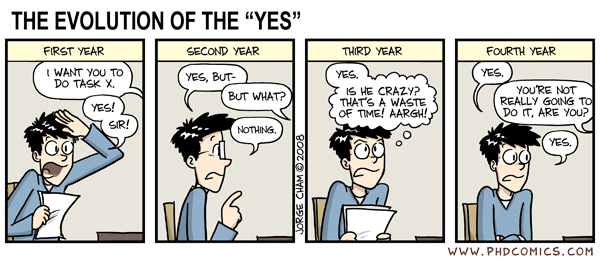
Ich bewege mich irgendwo zwischen zwei und drei...

Mit besten Empfehlungen - der PhD Comics Feed ist immer ein Abo wert!

Samstag, September 20, 2008

Wikipedia-Fundstück

Beim Recherchieren für den letzten Post über Kopfschmerzen, Salicylate und Pflanzensignale bin ich in Wikipedia über etwas witziges gestolpert. Biber besitzen eine Analdrüse, in denen Sekundärmetabolite von Urin hergestellt werden. Das Sekret heißt tatsächlich Bibergeil, und damit markiert der Biber sein Revier und pflegt sein Fell. Nebenbei wurde es früher auch medizinisch eingesetzt, weil es auch Salicylsäure enthält. Die Frauen dürfte interessieren, dass es als aphrodisierender Wirkstoff auch in Parfüms enthalten sein kann.
Darauf wollte ich aber eigentlich nicht raus. Es geht mir vielmehr um den Hinweis von Wikipedia, mit dem der Eintrag beginnt:
Dieser Artikel beschreibt ein Sekret des Bibers. Für den gleichnamigen Mediziner, siehe Horst Bibergeil.
Sorry an alle Bibergeils, aber das war in der Situation einfach zu gut!

Freitag, September 19, 2008

Was zum Ansehen

Hmm...könnte das Bild vielleicht bei gewissen Diskussionen mal nützlich werden?
fail owned pwned pictures
[via Failblog]

Mittwoch, September 17, 2008

The Singing Toxicologist

Adblock

He's been referred to as the "Elvis of E. coli", the "Sinatra of Salmonella," and in this episode of MicrobeWorld Video the "singing toxicologist." Whatever you call him, Carl Winter, Extension Food Toxicologist and Director of the FoodSafe Program at UC Davis, performs parodies of contemporary popular music by modifying lyrics to address food safety issues such as bacterial contamination, irradiation, biotechnology, government regulation, and pesticides. The goal of his songs is to provide science-based food safety information in a fun, accessible way. Thanks to a grant from the USDA, Dr. Winter is now studying how to integrate his music into traditional food safety education programs.


Dr. Winter's music goes beyond simply educating those who work with food and in this video he shares some of his tips to empower the everyday consumer looking to prevent the spread of foodborne illness.

Donnerstag, September 11, 2008

Physikerneid

Scientists from the Evolutionary Acceleration Research Institute (EARI) announced that the first test of the Giant Animal Smasher (GAS) will begin on December 19, 2008, the 41st anniversary of the premiere of Dr. Dolittle.

Dr. Thomas Malwin, head of the research project, said, "The first test runs will only accelerate microscopic life-forms like bacteria and viruses to high speeds, but theoretically the GAS can handle animals as large as squirrels, hence the squirrel smasher moniker."

Biologists from around the globe hope the GAS will unlock the secrets of the so-called "Darwin particle" that could unlock the secrets to life.
[via Pharyngula]

Dazu passt jetzt irgendwie dieser Comic von Nearing Zero:

Dienstag, August 05, 2008

Was zum Ansehen, bis ich wieder Zeit für richtige Posts habe

Leider hab ich mal wieder nicht wirklich Zeit für längere Posts, deshalb müsst ihr euch erst mal mit Bildern und Videos die Zeit vertreiben.

Über JoVE hab ich ja schon mal berichtet, und heute kam wieder ein Video über den Ticker, bei dem es um eine grundlegende biologische Methode geht: Das Lichtmikroskop und wie man es bedient.

Mehr in Richtung Unterhaltung geht ein Artikel von National Geographic über Aquarius. Die Aquarius ist ein Unterwasserlabor (das weltweit einzige?) der amerikanischen NOAA (National Oceanic and Atmospheric Administration) im Atlantik in ca. 30 m Tiefe. In diesem Unterwasserhabitat sind durchgängig Forscher stationiert, die das umliegende Ökosystem intensiv untersuchen. Der Vorteil eines solchen Habitats für Taucher liegt auf der Hand: Da das Habitat durchgängig in einem ähnlichen Druck wie das umgebende Wasser gehalten wird kann auf die langen Phasen des Ab- und Auftauchens verzichtet werden. So können Taucher statt vielleich 1-2 Stunden problemlos doppelt so lange arbeiten und auch mehrmals am Tag raus gehen. Davon abgesehen hat so ein Habitat natürlich auch einen Charme, der mit abgelegenen Stationen in den Polarregionen oder der ISS vergleichbar ist. Mehrere Forscher leben abgeschnitten vom Rest der Welt auf engstem Raum zusammen und sind von dem umgeben, das sie lieben: Ihrer Arbeit. Ich möchte trotzdem nicht im Versuchsgewächshaus schlafen müssen.
Die Aquarius wurde jedenfalls von einem Reporter der National Geographic besucht, und außer dem erwähnten Artikel finden sich auch mehrere kurze Videos über den Aufenthalt. Ich bin übrigens über den Wild Chronicles Videopodcast von National Geographic drauf gekommen, nur so als Tip am Rande.

Und zum Schluss noch was aus dem Failblog. Total offtopic, aber zu gut um es zu ignorieren.

Donnerstag, Juli 24, 2008

LUCA singt

Sorry, aber das muss ich euch einfach zumuten! Wie wir ja alle wissen, sind alle Lebewesen miteinander verwandt. Mensch und Schimpanse haben einen gemeinsamen Vorfahren, der einen gemeinsamen Vorfahren zusammen mit Gorillas hat, und so weiter. Geht man weit genug zurück, dann landet man bei einem theoretischen Organismus namens LUCA (last universal common ancestor; ausführlicher hier), der der gemeinsame Vorfahr aller heute lebender Organismen ist (jedoch nicht der gemeinsame Vorfahr aller Organismen, die jemals gelebt haben!).
Dieser LUCA hat jetzt jedenfalls sein eigenes Lied, zu singen auf - natürlich - Suzanne Vegas "Luka":
My name is LUCA,
I lived on the ocean floor
near some hydrothermal vent
or maybe in a tidepool by the shore.
And everything that's now alive
is my descendant that survived.
All the others went away (x3)

I'm not the first life. No,
that was way before my time.
Things were so much simpler then,
the start of evolution's climb.
Born in a world of RNA,
or some say protein, some say clay.
No one knows just what it was (x3)

Now if you feel inclined
to explore your family tree,
you're gonna have a real hard time
tracing your way back down to me
'cause horizontal gene transfer
has left the path a tangled blur.
Still, it wouldn't hurt to try (x3)

(repeat first verse)
[via Catalogue of Organisms]

Sonntag, Mai 25, 2008

kleine Ablenkung

Wie man zweifellos am Mangel von Posts merkt hab ich zur Zeit anderweitig zu tun. Bis zum nächsten "richtigen" Post könnt ihr euch die Zeit mit ner lustigen Geschichte vertreiben.

Lord of the Rings: an allegory of the PhD?

The story starts with Frodo: a young hobbit, quite bright, a bit dissatisfied with what he's learnt so far and with his mates back home who just seem to want to get jobs and settle down and drink beer. He's also very much in awe of his tutor and mentor, the very senior professor Gandalf, so when Gandalf suggests he take on a short project for him (carrying the Ring to Rivendell), he agrees.

Frodo very quickly encounters the shadowy forces of fear and despair which will haunt the rest of his journey and leave permanent scars on his psyche, but he also makes some useful friends. In particular, he spends an evening down the pub with Aragorn, who has been wandering the world for many years as Gandalf's postdoc and becomes his adviser when Gandalf isn't around.

After Frodo has completed his first project, Gandalf (along with head of department Elrond) proposes that the work should be extended. He assembles a large research group, including visiting students Gimli and Legolas, the foreign postdoc Boromir, and several of Frodo's own friends from his undergraduate days. Frodo agrees to tackle this larger project, though he has mixed feelings about it. ("'I will take the Ring', he said, 'although I do not know the way.'")

Den Rest der Story gibts hier.

[via Bayblab]

Mittwoch, April 23, 2008

Taxonomy fail

Dieses Bild vom Failblog hat mir heute den Tag versüßt:

[via Ugly Overload]

Donnerstag, Februar 28, 2008

Dass der Humor hier nicht zu kurz kommt...

...ein nettes Zitat eines Kreationisten. Es ist zwar schon ein paar Monate alt, ich bin aber erst vor ein paar Tagen darüber gestolpert. Besagter Kreationist legt mit dem altbekannten und zigfach widerlegten Entropie-Argument gegen Evolution los. Und dann wirds lustig. Sagen wir mal so: Jedes Kindergartenkind hätte ihm da weiterhelfen können, aber ich will ja nicht alles verraten.
One of the most basic laws in the universe is the Second Law of Thermodynamics. This states that as time goes by, entropy in an environment will increase. Evolution argues differently against a law that is accepted EVERYWHERE BY EVERYONE. Evolution says that we started out simple, and over time became more complex. That just isn’t possible: UNLESS there is a giant outside source of energy supplying the Earth with huge amounts of energy. If there were such a source, scientists would certainly know about it.


[via Cosmic Variance]

Samstag, Februar 02, 2008

Alternative Aviation

Auf dem relativ neuen Blog Science-Based Medicine wurde vor ein paar Tagen ein Post veröffentlicht, der die Denkweise der Alternativen Medizin mit einem Vergleich erkärt: der Alternative Flug. Sehr witzig, extrem empfehlenswert!
Das liest sich teilweise auch wie der Stuß, den Kreationisten oder die Anhänger des Intelligent Design in ihrem pseudowissenschaftlichen Slang verzapfen:

Philosophy

The underlying philosophy of AA is simple. People need to be free to choose their mode of flight based on alternative concepts of gravity and alternative airplane design.

Current Western reductionist concepts of gravity revolve around European white men and their understanding of the universe through the scientific ‘method’ of experimentation. The current concept of gravity from Einstein and his Theory of Relativity, whereby ‘mass’ causes ‘space-time’ to ‘warp’ and this is what Science calls gravity. This theory (and remember it is just a theory) is only one narrow way of defining gravity, one way of knowing gravity. There are other ways of knowing and an equal number of ways to understand gravity and flight. Alternative aviation operates using holistic, environmentally friendly, passenger centric methodologies the allow the passenger to be involved with all aspects of their airline flight. By actively applying the concepts of complementary and alternative medicine to the airline industry the successful revolution that has occurred in health care can now be seen in air transportation.


Aber am besten gelungen fand ich den Absatz zum homöopathischen Flug:
Aviation based on principals of homeopathy is especially promising. Airplanes, once they have flown their route, remember the route due to the principals of quantum complementarity. Then by making the planes smaller and slower by repeated factors of 10, planes can carry more passengers, go faster and farther with each aeronautic dilution.